Bengali

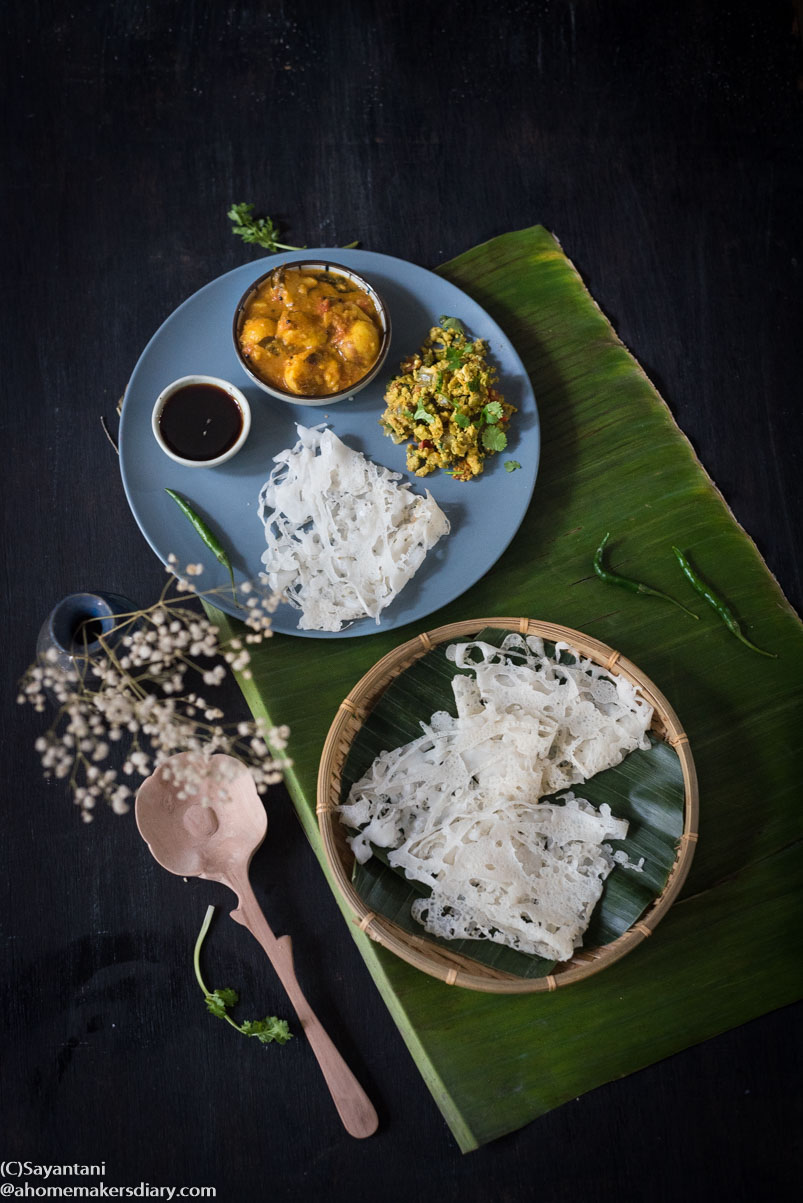
Chit Ruti or Chita pitha

6:00 PM


What is your traditional breakfast is a question that I often face. Especially from the foreign guests during our cuisine walks, all curious about Bengali food after a leisurely discussion and walk through the fascinating Gariahaat market.


The first time I heard this question, I got a little startled and could not reply quickly. Honestly, the breakfast that I have most days is toast and egg which in no way is a traditional breakfast. It rather is a hangover from the 200 years of the British Raj and Bengal being its capital for about 139 years (1772-1911). The other popular breakfast items most Bengalis would drool over and get nostalgic about be it luchi, kochuri or Radhaballavi are occasional/ festive breakfasts not to be had daily.

Read more by clicking on the heading...

Bengali

Chitoi Pitha and it's many variations

8:34 PM


 Another year has gone by.

I am another year older, probably another year wiser and if anything to go by my kids- I'm another notch cynical too.

Cynicism has never been my personality trait but I guess ageing slowly is not only giving me salt and pepper hair but also is toning down the tolerance level that I once was so proud of. And if that wasn’t enough,  I do not even shy away from showing my disapproval at times.


One of the things that I probably would never be in terms of, is the idea of fusion cuisine without getting the basics right. Please don’t get me wrong here. I strongly believe that food should evolve and change but at the same time am a big believer in preserving our heritage, our food culture, preserving everything that invariably is ours. So, while I will vehemently agree with you that ‘authenticity’ in food is tricky but at the same time honouring the origin of a dish and knowing the background is of utmost importance too.

Read More by clicking on the heading...

Bengali

Kholajali Pitha

10:31 PM

Eggs and fish in your pitha? As she asked the question, I could see her nose twitching in disdain. But the 10 years old me by then was seasoned enough to deal with such questions and hardly cared enough of what others thought of my food. So sharp went my answer  ‘ yes, fish and egg and they are quite delicious too. If you want to try here it is.” My open tiffin box with sobji and macher puli (fish stuffed rice cake) went as an offering.

What happened after that is not the subject of this post. Rather when I look back to this I see a perfect case study for what Edmund Leach explained as, ‘cooking is thus universally a means by which nature is transformed into culture and categories of cooking are always peculiarly appropriate for us as symbols of social differentiation.” As a self proclaimed student of food studies this often brings me to the question whether in a country characterised by the caste system we are defined by what we choose to eat and vice-versa.

Food has a thousand connotations, you could look into it with a rose-tinted glass of nostalgia, can play with it to create a sensory experiences, or can use it as a divisive weapon.  The choice is yours to make. But with the rising intolerance in society, it is becoming more obvious how we have a preconceived notion of what is food and what is not. This is not a new phenomenon. Wading through the pages of history and anthropology will reaffirm that food preference and culinary intolerances are as old as humans coming together to form and live in society. As Claude Levi-Strauss said, “food emotions are just a learned aspect of cultural conduct and member shipping which however contribute powerfully to the creation and maintenance of social boundaries, kinship system, and power hierarchies”.

Truly, As dictated by society, this culinary casteism not only decides what is food and what is not but what kind of food should be eaten on what occasion.

The incident that I narrated, in the beginning, is an example of that. Poush sankranti in West Bengal, for the Hindu Bengalis is as much a cultural festival as it is religious. While celebrating the new harvest we offer puja to the giver of food, Goddess Lakshmi or Dhanyalakshmi. As a custom, we abstain from anything non-vegetarian during this time. But in Bangladesh for the Bengali Muslims it’s the joy of the new harvest that they celebrate with good food both veg and nonveg. The food here is an important marker to identify who we are as a group. It is on us whether we use it as a marker to differentiate and shame or embrace the diversity.

I was lucky enough to grow up in a household where food was food, It never mattered from which community the food practice or recipes ever came from. The only marker my parents allowed in their kitchen is 'it had to be tasty and nutritious'.  We loved our Dhuki pitha with khasir mangsho (goat meat) that Rowshenara masi will cook for us in winter or would never twitch an eye to pair our soru chakuli pitha with duck meat or duck egg curry or making Macher or shutki macher pithe (dry fish stuffed pithe). 

But that was at home. In the outside world our choices were often questioned. along with our native food from Midnapore which many people thought were the food of the poor and ridiculed us for eating those. It hurt me badly as a kid but with time I learned to deal with it. 

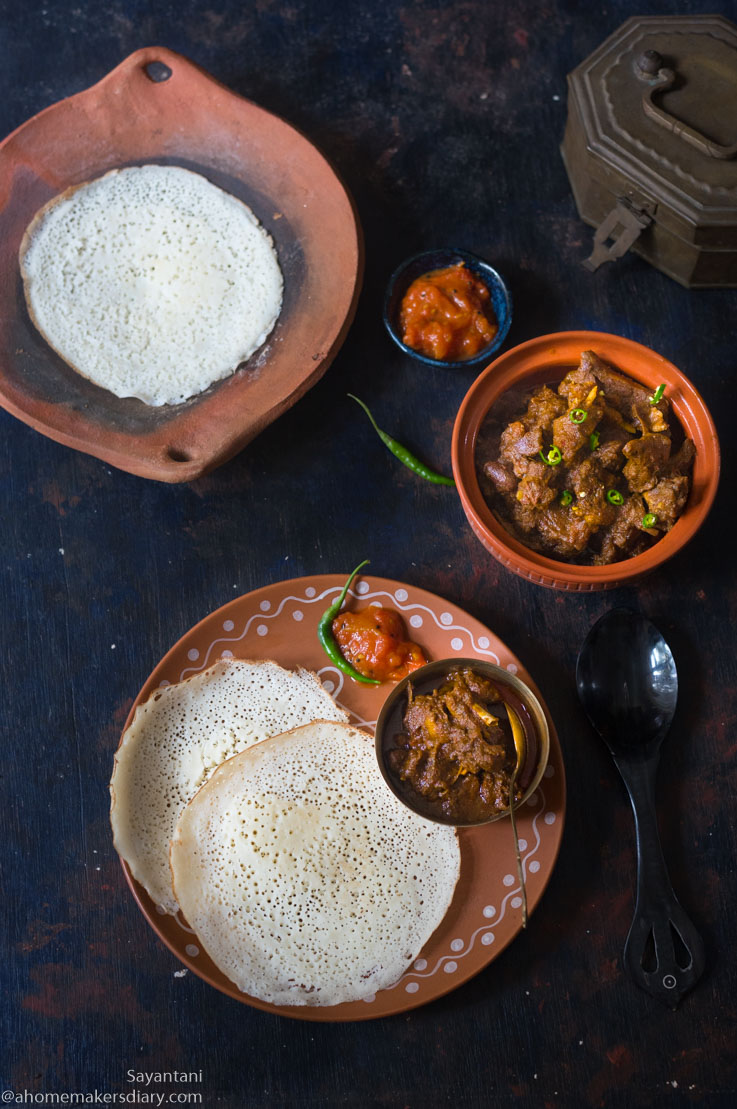
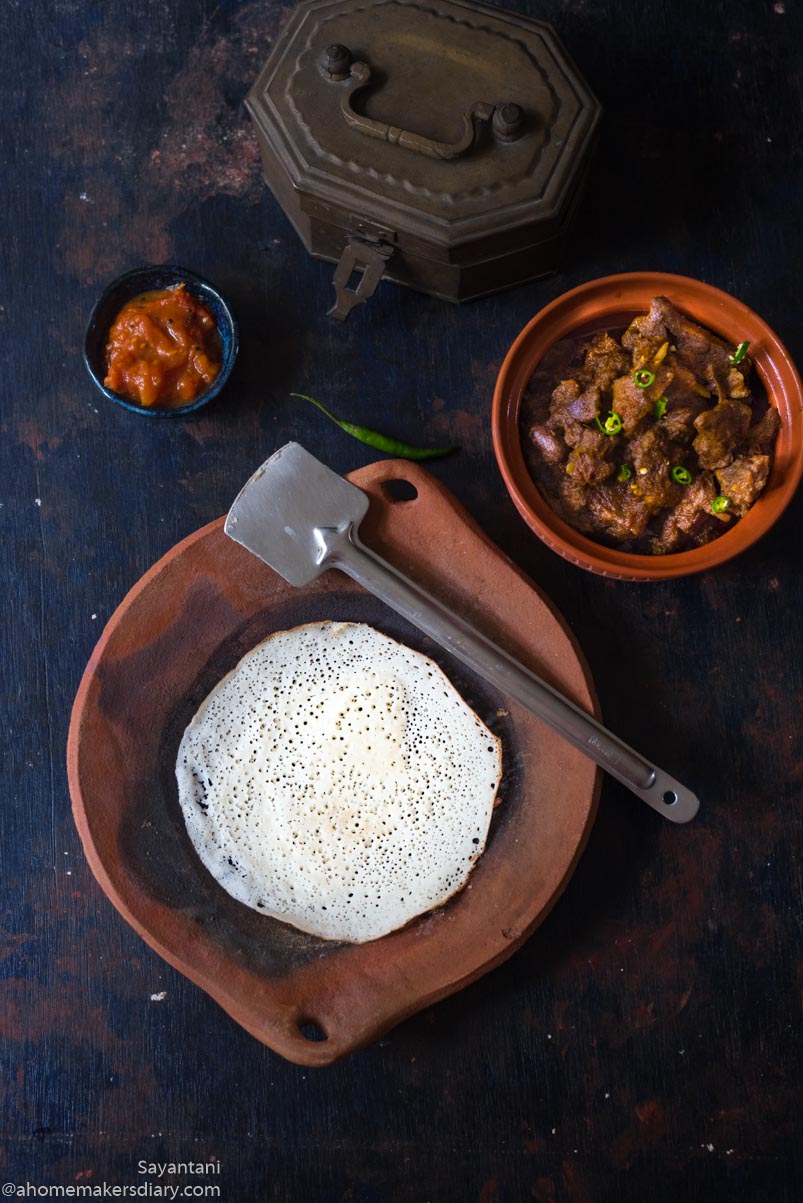
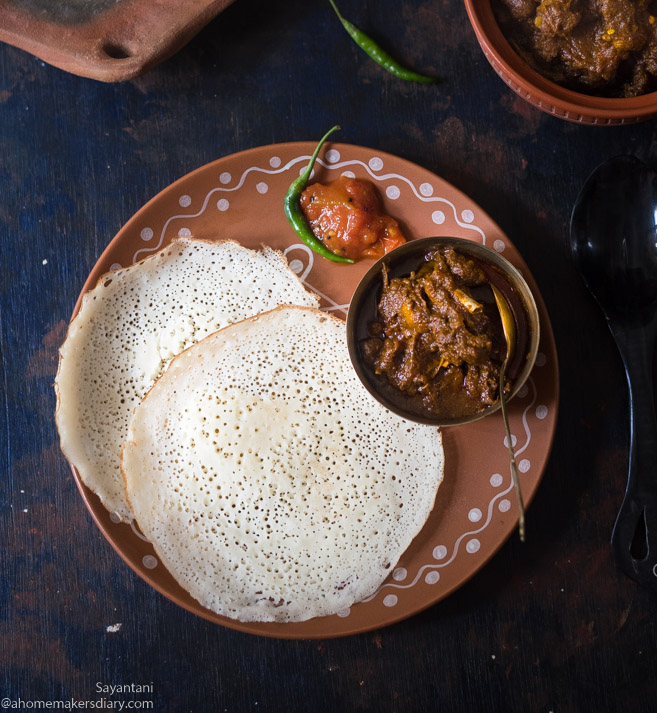
Another aspect of food that intrigues me is how food travels from one place to another and we can draw parellels between food from different geographical locations. When I look at this kholajali pithe with the numerous tiny holes on the surface, it instantly reminds me of Kerala's Appam, Moroccan Baghrir or Malaysian Apam Balik. Probably another fascinating and unknown journey of food from one place tracing which we can learn a lot about the journey of our ancestors. Thier journey for survival, the cultural amalgamations and people embracing food, making it thier own and adapting it using local ingredients and techniques.

Though same in texture, kholajali for me is more complex in technique - as it does not use any leavening agent like the other two. It uses a simple fact that when liquid batter touches the very hot surface of an Earthen pan it creates vapour, while trying to escape the vapour in turn creates hundreds of tiny holes giving it a net like appearnce. It’s the sheer ingenuity of our ancestors who played with a handful of items and applied various techniques to come out with so many different types of pithes with different textures, shapes, and tastes.

As a food enthusiast it’s an honour for me to learn and document those for the future generation.

The name kholajali refers to the words 'khola' or Earthen pan and 'jali' or net. While the first refers to the Earthen cooking pan/tawa the later, to the unique net-like texture. I believe this pitha originated in the Eastern parts of Bengal and is very famous in the Noakhali district of Bangladesh.

One can pair it with either sweet or savoury sides. In our home, it’s a winter ritual to have it with a spicy duck meat curry called Haser mangsher kalia.

This recipe calls for only three ingredients which I am talking about in the following section.

Rice flour: If you are planning to make it I would urge you to make your own rice flour which with the help of a mixer grinder is not a very difficult job. I in my next post will try to write in detail how to make your own rice flour.

Alternatively, you can soak atop or sundried rice overnight and can make a smooth paste out of it to make this pithe.

Egg: if possible use duck egg or country chicken egg as they are bigger. If you are using poultry eggs please substitute each duck egg with 1.5 of those.

Water: we need to use both warm water and room temperature water. Please read the recipe to know which one to use at what stage.

Earthen tawa: That gives the best result and we need to heat the Earthen pot on medium heat (gas burner) at least for 10 minutes before starting the process.

In case you do not have an earthen tawa use non-stick or seasoned cast iron one.

 Kholajali Pitha

(Makes 7-8)


Ingredients:

Rice flour: 1 cup (atop or raw rice)

Duck egg: 1 OR poultry egg one and half

Pinch of salt

To season the earthen pot 1 tablespoon of mustard oil mixed with 1 tbsp of water

Method:

Preparing the batter

Sieve the flour and place it in a big bowl. Add a pinch of salt.

Heat 1 cup of water till the water starts to simmer. Take off and mix with the flour. Depending on the quality of the flour the quantity will vary. Start with less water and gradually add more to get the right consistency.

Mix to get a lump-free batter and keep it pourable yet thick like a slightly thinner pancake batter.  Keep it aside for 5-7 minutes till it cools down a bit then add the egg and mix.

Now adjust the consistency with room temperature water. The thickness should be enough to pour and spread easily by swirling the pan. Please check the associated video.

Cooking the pitha.


Check this video to understand the consistency of the batter and the cooking technique

Heat the pan to very hot then keep the heat to medium. Take the oil and water mixture in a small piece of cloth and wipe the surface of the pan. Pour a ladleful and carefully by holding the two sides of the pan swirl it to cover the surface. Cover the pan with a lid and cook on medium-high for 30 seconds or till the top changes colour and is cooked. Using a khunti or a spatula take it out.

Serve hot with any side of your choice. 

Bengali

Wild Green Fritter

7:10 PM

Wild greens pakoda...am in love with how pretty this platter looks

One of the fondest memories of my childhood was to wander around the paddyfields. People say that I spent hours jumping from one place to another chasing the crabs, insects or birds and watching small fishes swimming between the paddy seedlings. That love is still there. Whenevr I go home to Midnapore or 24 parganas,  I get up early and take a walk around the village and deep inside the fields looking for those familiar sight and smell. It is here that I learnt how paddy fields provide a nutritious meal even to the poorest of the poor people. The small mud crabs, even smaller fishes along with the numerous greens growing as weeds come together in a simple curry to provide all the required protein, vitamin and micro nutrients prescribed by dieticians.
Continue to Read More... 

Bread Paratha etc

Namak Mirch ka Paratha

6:30 AM


Today is the 19th day of India under lockdown. Something that started with a lot of apprehensions and fears slowly is becoming a new normal. People working from home as much as possible. Kids learning through online classes and each of us is trying our best to make sense of this changing time in our own unique way.

Bengali

Kolkata style Aloor chop

8:13 PM


I was waiting for the rain God to bless us with some heavy downpour to bring out my deep-frying mode. Not being a lover of deep-fried goodies I really need a reason to bring those calories to my plate. and am happy the rain is finally here.

Monsoon this year is late. very very late.

So late that most farmers were worried to death as it delayed plantation. But as they say better late than never, we are happy that rain is finally here in full throttle. and what better way to embrace the season than some piping hot alur chop and cha?

bengal

Panta Bhat and accompaniments recipe

8:08 PM


So here are the promised recipes for the panta and few of it's many accompaniments. Guess I have written enough on my previous post about this meager meal so now let me delve into the recipes right away.

Here I have given an idea of how much of what is to be used. Giving an exact quantity is quite difficult. Follow your taste preference and you would be fine.

All the recipes given here are for 4 servings

Panta Bhat

Q. What kind of rice to use? Sundried or Boiled (seddho or atop)?

A: I have seen normal non-hybrid variety, boiled rice (seddho chal) lends itself better to the process of making Panta. They soften and disintegrate naturally and bring in a slightly tangy flavour. You can even use sundried rice (atop) but it has a distinct flavour which I personally do not like in my Panta.
Similarly, short grain rice is better for this recipe.

Bread Paratha etc

Tandoori Roti made on Tawa, Stove top, Video recipe

7:43 PM


Many of you asked me on my instagram account about the rotis in my Sarson ka saag recipe. Yes, they are Tandoori rotis but made from scratch at home. And No, you don't need a tandoor or even an oven to make them at home, also they are very easy to make. Much easier even than normal tawa rotis, which I believe we all have struggled with at some point in time.

Bengali

Maa's Sobzi dewa Nonta Puli (Savoury Pithe)

7:47 AM


The first house we ever lived in Santiniketan had an unusual floor plan. We had to enter the second floor that we rented from a man in his seventies through a staircase in the garden. The entrance was halfway through the stairs and the whole second floor was divided into various levels. The kitchen, for example, was higher than the main living area. We had to take 6 steps to enter a narrow red oxide kitchen with big windows on both ends. The bathroom and the small round verandah were lower with 4-5 steps down the hall. We had only two bedrooms and a small hall but we never complained because it had a sprawling garden with almost all sorts of fruit trees and a huge terrace. We spent most of our waking times there and in summer even we slept under the stars. 

Breakfast

Kalabhat-yogurt-mango breakfast parfait

8:08 PM


Though as a grown up I dread summer but when I look back, Summer evokes such fond memories of childhood vacations spent at grandma's. Those were the simplest times with pure joy found in everything.
My Mama bari or maternal home is in a very remote village of Midnapore near the Coast did not even have electricity back then but we never missed it. we had friends and cousins to play with, pure unadulterated nature to explore and loving family and home to come back to. Everything was pure in what they offered. We had the most basic food foraged, caught and collected from our own farms, cooked by Dida. Even the breakfasts were simple affairs.

Bengali food has always been based on the principles of Ayurveda following which we not only include each of the six tastes to our meals for a more nourishing and fulfilling experience we also base our diet on easily digestible rice based products. Apart from various types of rice that contributes as the main carbohydrate to a Bengali diet there are numerous other rice based products like Muri (puffed rice), Chire (beaten rice), Khoi (puffed rice in it's husk), Chalbhaja (Another type of puffed rice but not as puffed and little spicy), khud (broken rice)  etc that makes our breakfast and snacks wholesome and filling.

You will hardly find a Bengali who have grew up in the 80's or before not have had Doi-chire-Aam as summer breakfast. Doi here refers to homemade yogurt and mostly chinipata doi where sugar is added to the milk before adding the culture. This Chinipata Doi often were our desserts during summer days even in our family this was served as a part of wedding meal. 

This Kalabhat parfait is born from that memory of my summer vacations and Doi-chire-aam. IF you know me then you know I do not suggest or recommend anything unless am very sure of it. And this Kalabhat parfait is a delicious thing to start your day. Kalabhat or black rice is naturally high in anti oxidant and contains anthocyanin that fights cancer and helps in reducing inflammations. Naturally gluten free, full of fiber and rich in protein content and so very versatile too. You can use them as steamed rice to pair with your curries, add in stir fries or salads, make desserts and even add them in your soup. Trust me this chewy slightly glutinous grain is a delight to have.

Breakfast

Handvo (Gujarati Lentil and rice Savoury cake)

6:51 AM


Remember that movie three idiots where drunken Kareena says to Amir Khan, tum Gujarati logo ka khana itna khatarnak kyon hota hai???? Dhokla, Fafda, handva, thepla...aise lagta hai jaise koi missiles hai ..." (why does the name of Gujarati food sound like dangerous weapons? Dhokla, Fafda, Handva, Thepla...sounds not like food but missiles).
Exactly my thought. I love Gujarati food especially their elaborate platters but the names always bring a smile on my face. while we were growing up we only heard of Dhokla, that quintessential sweet shop staple for breakfast. Yellow spongy squares of steamed gram flour batter soaked with a salty sweet spicy syrup and sprinkled with coconut and not so fiery fried green chillies. Seriously I can survive on this snack with some hot tea. but now with the globe opening up and people being interested in various cuisines more of Gujarati food are coming into limelight and more such names are being familiar. and I don't see anyone complaining. 

Breakfast

Dalia Upma for Seed the Rise

5:00 AM


Seed the rise #seedtherise is an fund raising initiative to support and give back to the Indian farmers, who work day in and day out irrespective of the harsh weather for us to get our daily meals on the table. If you are aware then you might have read about the poor condition of the Indian farmers in many states. The extreme and fluctuating weather conditions, the erratic demand in the market, the changing policies of the importing countries, Price cut and steep competition from other exporting countries are making their condition worse and in many states the distressed farmers are left with no choice but to commit suicide to maintain their dignity. The study says that on an average one farmer commits suicide every 30 minutes. 

In such circumstances Mahindra has come up with this noble initiative to help them overcome the odds. They plan to collect Rs.2 Crore from People and they will match the same amount. The money will go to 5 impactful projects  run by NGOS working towards improving the lives of the farmers and their families. 

Popular Posts